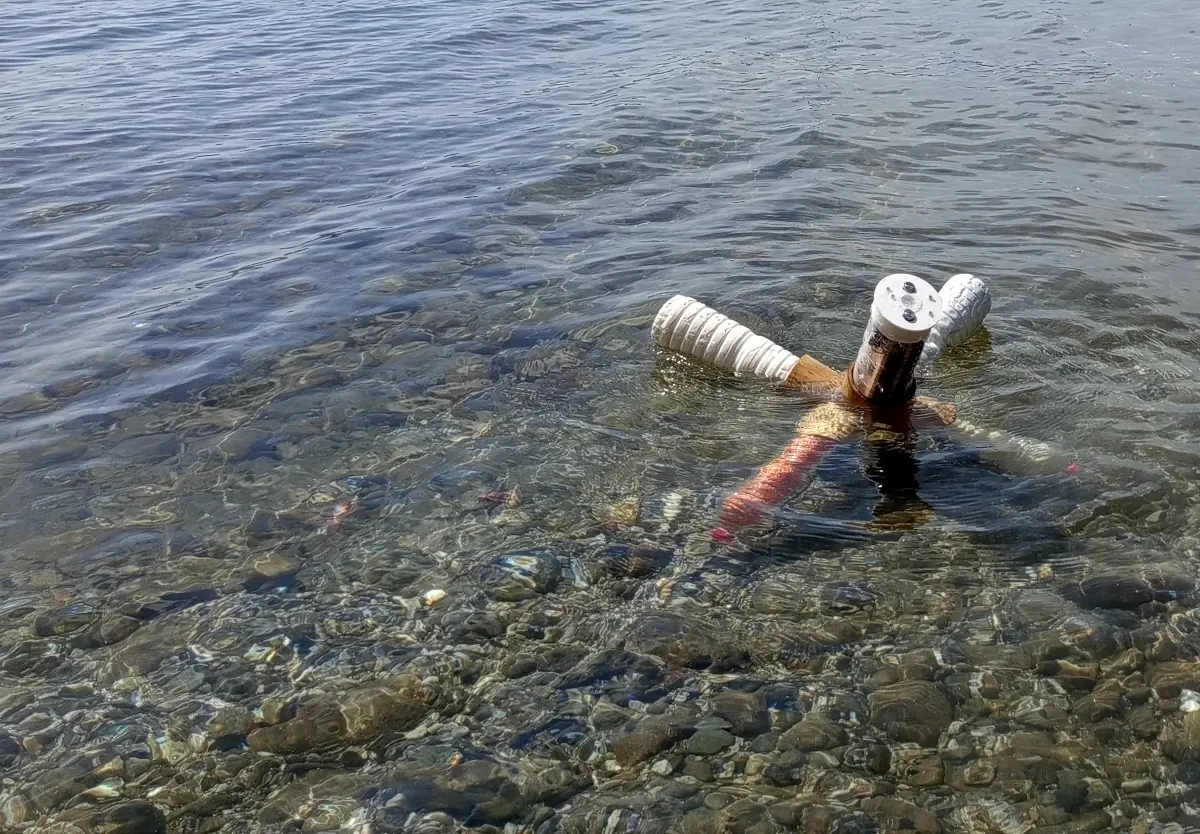
The Human2Human project aims to bring hope and humanity to our fellow humans in the most hurting and isolated places on the planet — in a way that doesn't trouble the health and happiness of animals, fish and other our fellow creatures in the ecosystem. To do so, we've developed the hope turtle: a non-capital, open-source, autonomous marine vehicle that embodies Earthen principles. Turtles are made from locally available and 95% organic materials in such a way that anyone around the world can build them-- and make them better! Rather than relying on centralized, traditional logistics to deliver aid, turtles enable humans to mobilize collective decentralized delivery direct to those who need it most.
Each Hope Turtle is a buoyant marine vessel built primarily from bamboo and repurposed bottles — materials that are widely available, inexpensive, and biodegradable. Inspired by ancestral Austronesian seafaring traditions, the design harnesses ocean currents, wind, and solar energy rather than fossil fuels. Version 1.0 is a hand-assembled structure that carries six food-filled bottles as payload. Version 2.0 integrates onboard electronics, GPS navigation, telemetry, and self-steering — enabling independent voyages across hundreds of kilometres of open sea.
The project is grounded in Earthen ecological principles and a commitment to radical transparency and non-violence. All designs, source code, and research are publicly available. The vessels are engineered to be as organic and biodegradable as possible — so that even if a turtle ends its journey unexpectedly, it leaves behind nutrition rather than pollution. This regenerative philosophy extends to the platform, the community, and the culture of the project itself.
Our Core Principles
- For-Earth: Turtles are made with the health and benefit of the biosphere and the local biome and ecosystem first and foremost. While this focuses on the well being of humans in a particular locale, it also and equally includes the animals, plants and other organisms there too. Mindful of the various species we will benefit (fish, whales, humans) we do not distinguish along human political lines.
- Love & Non-violent: Turtles are designed as acts that acknowledge the hurt and needs of locale. Before sending we actively listen and hear the needs of the humans there and contribute in a way that doesn't hurt other humans or actively benefit one group of humans over another.
- Open Source: All the code, designs and specs are shared in such a way that they may be copied and used by others along our same principles.
- Locable: We use only materials that can be sourced just about anywhere in the world locally (bottles, wood, generic electronics).
- Non-capital: Turtles are designed from the ground up, not to rely on capital intensive platforms, technologies or components. Yes, money is still important, but by prioritizing locally sourceable, often discarded materials (PET bottles, pallet wood, etc.) capital does not become a barrier to replicability.
- Spiral: We make sure that all of our components and materials can be cycled again in a way that is beneficial over many such cycles for humans, animals and ecosystems. This means using reusable and biodegradable materials just as much as it means avoiding for-profit platforms, technologies and services.
The Hope Turtle Project is not simply a technology project — it is an invitation. An invitation to imagine and embody a world in which compassion travels freely across borders and oceans. By keeping costs low and designs open, the project is built to grow: engineers, makers, sailors, and communities everywhere are invited to build their own Hope Turtles, commission deployments, and join a growing global bale of people committed to turning concern into care. Every turtle in the water is a small, humble, powerful act of hope.
Consequences
- 100% Reusable: Every element of the turtle can be readily repurposed. From the screws to the wood, from the bottles to the sensor circuits, each element can be removed and reused.
- 95% Biodegradable: The net weight of the turtle will be materials that biodegrade (wood, bamboo, canvas, etc.) or which are inert and non-toxic (steel screws, silicon board). We avoid the use of new plastics as much as possible.
- 100% Fixable: All elements of the turtle are repairable and replaceable, and we maintain documentation on how.
- Replicable and Improveable: Because our designs are open source, non-capital and locable, they can be readily replicated by folks around the world. As others follow our principles, their work can be replicated also. As we all iterate, our designs get better and better in ways that none of us could foresee.
- Low Cost: Our goal is to keep the net fabrication cost of a turtle below $100.